View the Series on Amazon For Instructors
The Adaptive AI Codex SeriesBuild It. Break It. Defend It.
A practical, code-first series for anyone interested in building, understanding, and securing AI systems — by Eric Yocam PhD, DBA.
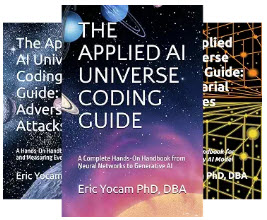
Three books, one continuous journey. Book 1 builds real AI models from the ground up, from classical machine learning through generative and quantum AI. Book 2 attacks every one of those models with real, executed code, verified against the actual notebook. Book 3 defends every one of them — and then measures each defense a second time against an attacker who knows it is there.
The Three Books
One Model Universe, Three Passes
The same models run through all three books, which is what makes the comparison meaningful. A model built in Book 1 is attacked in Book 2 and defended in Book 3, using the same cached weights each time — so the before-and-after numbers describe one system rather than three unrelated ones.
- Book 1 builds more than thirty models, from a rule-based expert system to a variational quantum circuit, and asks whether they work.
- Book 2 attacks every one of them and asks how they fail — publishing the attacks that succeeded and the ones that did not.
- Book 3 defends every one of them, then asks the harder question: how much of that defense survives an adversary who is paying attention?
The answer, aggregated across every chapter, is that 71% of the apparent benefit survives and 29% does not — with the loss concentrated almost entirely in detection defenses, and none at all in integrity controls. Book 3 reports that about its own results.
Companion Code and Model Artifacts
Every book ships with executable Colab notebooks and a Hugging Face repository of the models themselves — built, attacked, and hardened — so any figure in any book can be reproduced rather than taken on trust.
The Guiding Philosophy
The Adaptive AI Codex Series is built upon three principles:
- Practical - Every concept is reinforced through working code and hands-on experimentation.
- Accessible - Complex topics are explained clearly without sacrificing technical accuracy.
- Security-Aware - Understanding how systems fail is essential for building systems that can be trusted.
- Measured - Every number in the series comes from a cell that actually ran. Negative results, failed defenses, and null findings are reported rather than removed.
Practical. Rigorous. Code-First.
Start with Book 1, or jump straight to the attacks or the defenses.
Start with Book 1 Explore Book 2 Explore Book 3